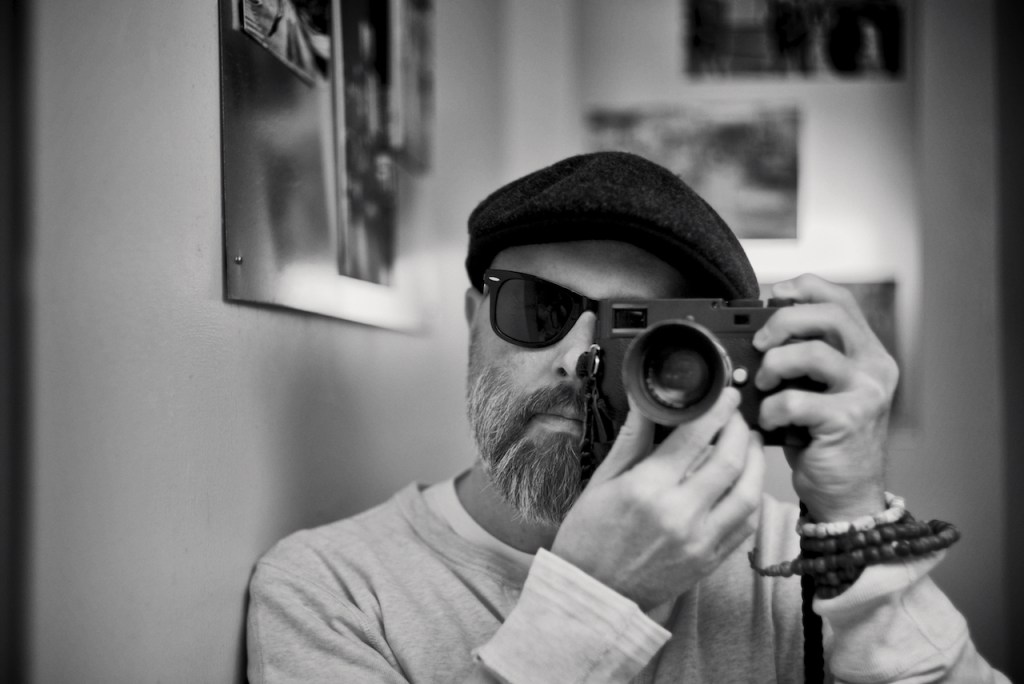
Q: To begin, tell us about yourself? Please provide some details on who you are, your background as well as your motivations and goals in photography.
A: Who am I? I am a man with a passion for photography, coming to it later in life, although it’s always been something I’ve enjoyed doing. My primary motivation for the making pictures is to document my life’s journey.
Q: How would you describe your photography? What genre are your photos? (e.g., fine art, photojournalism, portrait, travel, etc.)?
A: I’ve moved away from putting myself in one genre. Certainly a lot of my work could be called ‘street photography’… I like the term a friend recently used, humanistic photography. I photograph what is interesting to me at any given moment the camera is with me. I also currently shoot solely in black and white. I look for moments on the street, bus or in my home, wherever I’m at. I’ve yet to settle on one theme, although I am drawn to the every day or that which is seen but dismissed or forgotten. I’m interested in a story. And everything and everyone has a story to tell. A photograph is a moment in that story. You may know or learn about the story before or after the made moment, but you may not, in which case you only have that one moment on which to go by. It’s all very interesting. Photojournalism is something I’ve always been interested in. I actually applied to the University of Wisconsin Madison’s Photojournalism program in the early 90’s. I was not accepted to the university–something I laugh about now that I work there–and soon after put photography aside for nearly ten years.
Q: What is challenging for Michael?
A: I think one of my biggest challenges is feeling confident as a photographer. I don’t have formal training as a photographer or artist. I would like to take on projects but feel I lack the knowledge on how to get one going; who to contact, getting permission to photograph, developing a story to tell. I like things to happen organically. So coming up with a preconceived, conceptual project is challenging and scary for me.
Q: One could say art is everywhere and there’s something to be said about photographing the everyday. Do you agree? Is your camera within reach and your eyes open all the time?
A: Yes, I believe art is everywhere, but we all see it differently. The everyday, the mundaneness of a street scene, people in a coffee shop, a woman reading a map on the bus, are scenes we see so much that most are not attuned to the uniqueness of these scenes or moments, and simply dismiss or filter them out. But I’m interest in these fleeting moments. It’s all these moments that make up a persons day and ultimately life-story.
Q: Was there a photographer or type of photography that has influenced your work or inspired you?
A: Yes. I’ve always enjoyed the work of Henri Cartier-Bresson, William Eggleston, Stephen Shore, and most recently the found photographs of Vivian Maier. Robert Frank and Walker Evans have also both been very influential on my work and approach to photography. I’m also inspired by what I see daily from my those posting to Instagram or Facebook. The web has allowed not only the instant viewing of great photography but has allowed those who would normally not have gotten any exposure, like myself, to be seen, validated and empowered to do more.
Q: Did you have any formal education in photography, with a mentor, or were you self taught?
A: As I said earlier, no formal education or training. I’m self-taught. I do have an eye for photography, and in my opinion that is what is most important. In 2014 I attended Filter Photo Festival in Chicago, IL. Wow! It was an eye-opening experience to say the least! Having not been part of the fine art photography world before I left Filter with a renewed sense of purpose and direction. In addition, I met some wonderful, wonderful photographers who have been incredibly helpful. I feel part of a community now.
Q: When did you first become interested in photography as a mode of expression or art form?
A: I’m not sure. When I was young we always had camera’s around. These were instamatics and polaroids, nothing fancy. In the ’80’s I attempted using a 35mm film camera but found printing too expensive. It wasn’t until my first digital camera that I started to get serious about photography.
Q: Where does “new normal” come from?
A: My master’s degree is in counseling psychology. When I had my internship at St. Mary’s Grief Support Center in Duluth, MN, my supervisor was a leading grief expert in the country. He always used the phrase ‘new normal’ when talking with clients about how to go on after the death of a loved one. People would always want things to, “get back to normal” yet that was impossible now that your child, friend, parent, partner, or spouse was gone. You were working on creating a new normal.
Q: What is your equipment? Do you have a favorite lens?
A: I prefer a digital rangefinder with a 35mm or 50mm lens.
Q: What do you like in particular to working with a rangefinder camera?
A: One of the things I’ve most liked is the simplicity–the menu and settings are basic, so I can spend more time on making the picture instead of putzing around with all kinds of settings. In addition, the size and weight of the camera is perfect. I was starting to leave my DSLR home more and more due to the size of the camera and lenses.
Q: How do you see your photography evolving over the next few years? Are there any particular places you would like to document or different styles of photography you intend to explore?
A: I would like to take a road trip and document it. I know this has been done a thousand times, but I haven’t done it! And we all see the world differently.
 new normal photography